
Cry over Leverage
On dreams, leverage, concentration, correlation, depreciation & debt

In 1998, Long-Term Capital Management ran on roughly 25-to-1 leverage, backed by two Nobel laureates, and blew up when Russia defaulted on its debt. Its $4.8 billion in equity was gone within weeks, but the real danger was the other side of the ledger: over $125 billion borrowed, more than $1 trillion in derivatives notional, counterparty exposure to nearly every major bank on Wall Street. The New York Fed had to broker a $3.6 billion rescue from 14 banks because letting it implode risked taking the system down with it.
Leopold Aschenbrenner’s Situational Awareness fund just gave us a 2026 preview: a long AI-infrastructure, short-software book, run at roughly 4x leverage, that went from $45 billion to a Citadel fire sale in days when chip stocks lost over a trillion dollars in value. The first data point in a much bigger one?
Here’s what the leverage actually looks like once you zoom out from just one Wunderkind fund.

#1 Wall Street Consensus Bet
Situational Awareness, despite its name, was running the trade. Goldman's prime brokerage data shows hedge funds entered the second quarter of 2026 with a record 10% weight in semiconductors, the highest on record, while software weight fell to 6%, the lowest since 2019. Software shorts hit their highest level since Goldman started tracking the data in 2016. Hedge funds made roughly $24 billion collectively shorting software this year even as the sector lost nearly $1 trillion in value. Point72 and Whale Rock were running versions of the same book. This is the same shape as 1998: LTCM didn't blow up because one fund was leveraged, it blew up because half of Wall Street was running the same convergence bet, so when it broke, there was no uncorrelated buyer left standing on the other side.
#2 Circular Finance
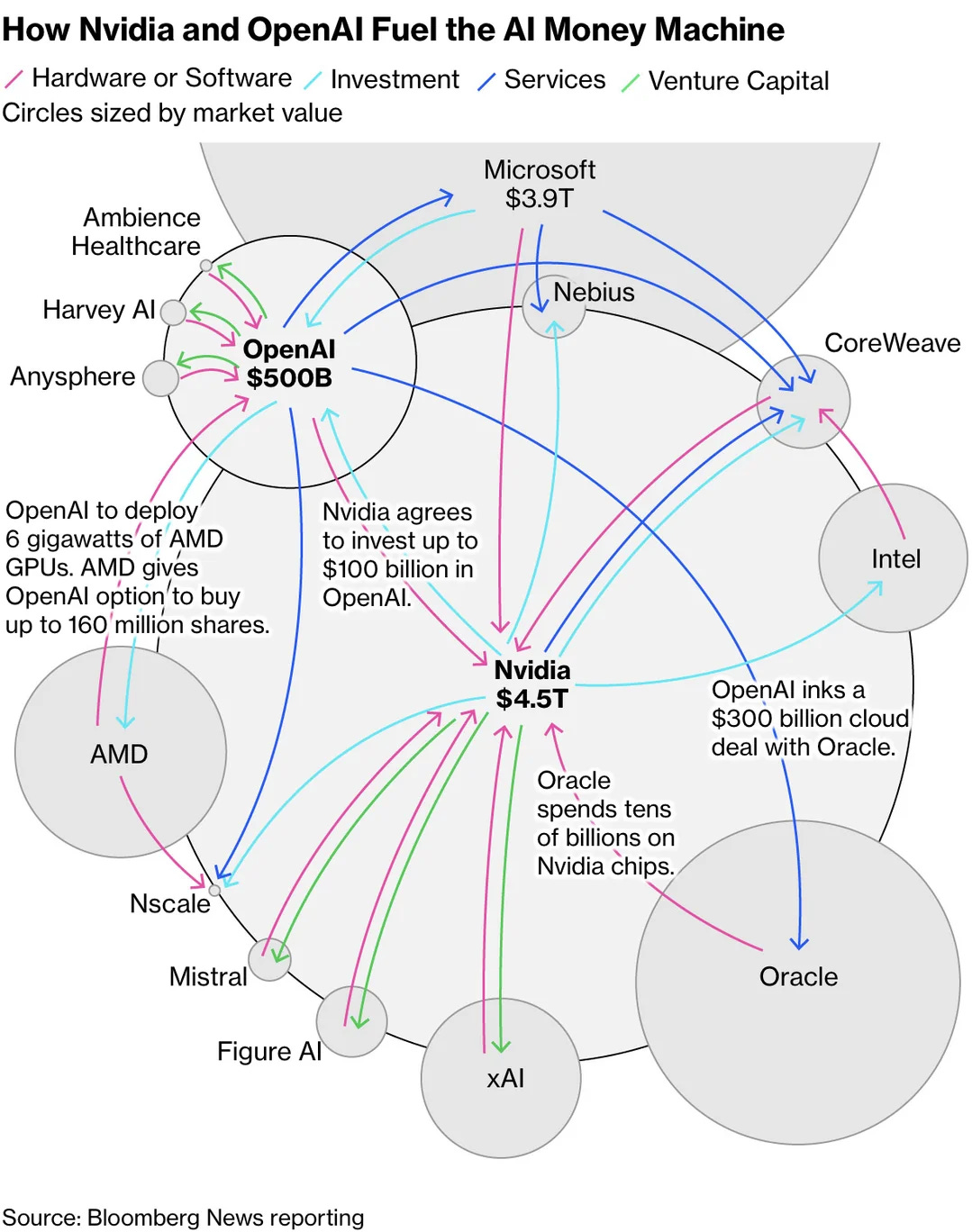
Then there’s the thing with circular financing within the AI Money Machine. Nvidia invests in OpenAI and CoreWeave while selling both of them the chips that make the investment thesis work, is reportedly discussing guarantees on OpenAI purchases worth hundreds of billions, and remains CoreWeave’s buyer of last resort for unsold capacity through 2032. Each company’s revenue depends partly on the other’s continued spending. That’s not the same risk as one hedge fund’s leverage, it’s closer to LTCM’s actual problem: interconnection. If one node’s assumptions don’t hold, the stress doesn’t stay put.
Add it up and AI-linked investment-grade debt now sits at roughly $1.4 trillion, about 15% of the entire US credit market. AI-linked stocks make up something like 45% of S&P 500 market cap, the highest single-sector concentration since just before the 1929 crash, per Deutsche Bank research. Aschenbrenner's fund was one leveraged bet sitting inside a system that is itself running startlingly leveraged.
#3 Infrastructure Buildout
What is actually being funded is the largest infrastructure buildout in history, and it’s already showing up on Big Tech’s balance sheets. Alphabet’s free cash flow turned negative in the second quarter of 2026, first time since its 2004 IPO. Meta’s collapsed 91% to $784 million as AI spend hit $31 billion in a single quarter. Amazon is projected negative $17 to $28 billion for the year. Investment-grade bond issuance backing AI infrastructure hit roughly $218 billion through early July 2026, already blowing past all of 2025’s $80.5 billion, with Morgan Stanley projecting $250 to $300 billion more from hyperscalers this year alone. Oracle is carrying close to $96 billion in debt after an $18 billion bond and a $38 billion loan, and some of that Oracle-backed data center paper has already needed to offer investors higher yields to move, an early stress signal. Meta closed the largest private credit data center deal in history in 2025, $30 billion for a single Louisiana facility. CoreWeave’s GPU-backed loan facility got rated investment-grade by Moody’s this year, which is interesting to look at: it means pension funds and insurers, the money managing our retirement, are now eligible buyers of AI infrastructure risk that didn’t exist as an asset class three years ago.
#3.1 ENERGY!
Underneath the balance sheets sits a physical constraint no financing structure can fix. The buildout needs energy that is fast enough to bring online, abundant enough to meet demand, and cheap enough to keep the economics working, and the US currently has none of the three in sufficient supply. Nearly 2,300 gigawatts of capacity, more than the entire existing US power base, sits stuck in interconnection queues with waits stretching past five years, and half of global data center projects are already delayed by power and grid shortages. Leverage can finance a data center. It cannot finance a faster transformer.
#4 Will These Assets Actually Hold Their Value? (aka China’s Open Models)
Even if the financing holds, the underlying product is getting cheaper faster than the debt assumes. China’s open-weight models are collapsing the price of intelligence: DeepSeek V4-Pro runs about $0.88 per million output tokens against $25 to $30 for the leading closed models, and GPT-4-class inference has fallen roughly 95% in two years. This is the telecom fiber problem from 2000 in a new costume, the infrastructure was real, it simply wasn’t worth what the debt assumed it would be. It’s a different risk than everything above it, not a solvency question but a durability one: will the revenue survive commoditization before the capex gets repaid.
#5 Uncle Sam’s Fiscal Space Problem
Here’s the part that makes this different from 1998. When LTCM blew up, the US government had real balance sheet to absorb a shock: federal debt held by the public was well under 50% of GDP, and interest costs weren’t a binding constraint on anything. Today, the FY2026 deficit is projected around $1.9 to 2 trillion, close to 6% of GDP. Interest payments on the debt alone are around $1 trillion this year and, per CBO, are on track to more than double by 2036. Debt held by the public is already above 100% of GDP, heading toward 120% within a decade. The Committee for a Responsible Federal Budget has flagged that the average interest rate on that debt could exceed GDP growth starting around 2031, the textbook setup for a debt spiral.
#5.1 Treasury Yield, all time HIGH!
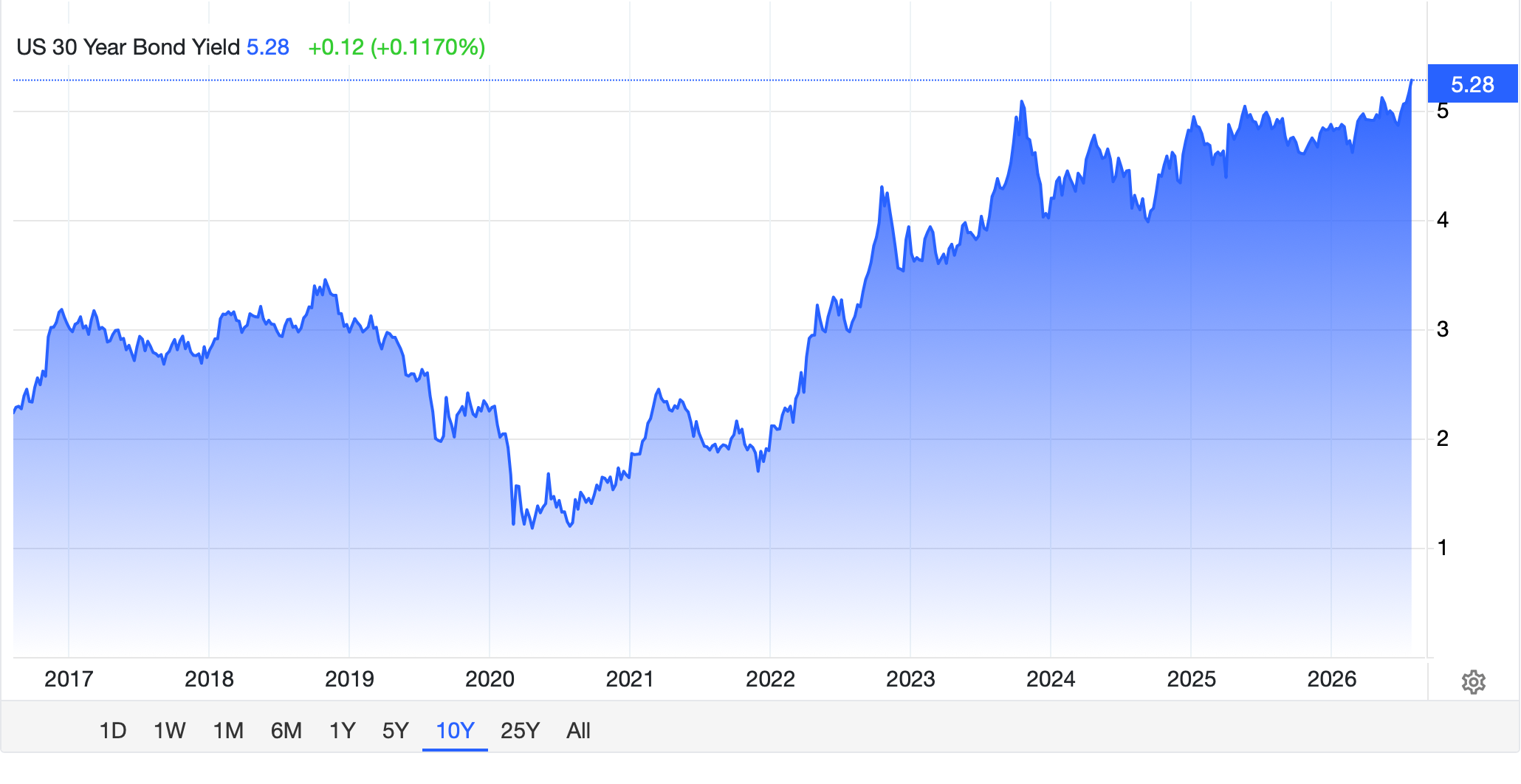
The 30-year Treasury yield closed at 5.28% on July 31, the longest stretch above 5% since 2007. Above 5%, Treasuries become real competition for capital, a pull that grows every time a signal like the Aschenbrenner news lands. Normally that rotation cushions the fall. It might not work that way this time. Stocks and long bonds have been selling off together in 2026, the correlation the 60/40 portfolio depends on has flipped positive, closer to the UK gilt crisis of 2022 than a normal correction, and China's Treasury holdings have fallen roughly 50% from their 2013 peak. But then there are additional triggers: Iran and the Strait of Hormuz pushing oil higher, a newly hawkish Fed under a less predictable chair, three regional presidents dissenting for a hike in July, the first unified hawkish dissent since 2016, and the government has less room to catch a shock than it did last time.
Cry Over Leverage
Unbundled, it's one leverage problem wearing five costumes: #1 concentration, a crowded trade with few uncorrelated buyers left; #2 circular finance, the hedge that wasn't, showing up in Aschenbrenner's book and in the financing web both; #3 the infrastructure dream, capex and negative cash flow racing a physical grid that can't move faster; #4 depreciation, the durability question China's models are forcing on every AI valuation; and #5 debt, the backstop with less room and a bond market already pricing the difference.
EXCITED
There has never been a more exciting time to invest. Platform shifts like this happen once, maybe twice in a career, and the breakthroughs are real. I am extremely grateful to get to invest through this. Looking back a decade from now, this correction will for sure read as a rounding error against how much value actually gets created. But being right about the long term and surviving the short term are two different skills. Leverage always looks like conviction right up until it looks like a margin call.
P.S. — what does that mean for us? (aka VCs)
VC is the AI trade. AI took 86% of all US venture dollars in the first half of 2026, and OpenAI and Anthropic alone captured 43% of all global startup investment. This cycle has also picked up a leverage layer venture didn’t carry last time: NAV loans sitting senior to LPs, capable of tripping a covenant across an entire fund if one portfolio company is marked down hard enough. Denominator effect, falling public portfolios push LPs over their illiquid-allocation targets and they pull back new commitments before a single startup is even repriced, which is what happened at a smaller scale in 2022. Worth remembering given the exit market looks euphoric rather than cautious right now, record M&A, a $1.7 trillion SpaceX IPO, OpenAI and Anthropic both confidentially filed to go public, since IPO issuance peaked right before the Nasdaq cracked in 2000, not after.